The difference between a 4-star and a 5-star hotel is not one increment of quality — it is a step change in staffing, service hours, and space. A 4-star property is required to be comfortable and well equipped; a 5-star property is required to be staffed around the clock. In Europe's Hotelstars Union catalogue the dividing line reads like an operations manual: a 4-star hotel needs a 14-hour staffed reception and either a minibar or 12-hour drinks room service, while a 5-star needs a 24-hour reception, a minibar and 24-hour food-and-drink room service, plus concierge, valet parking, luggage service, evening turndown, ironing and shoe-shine service, and a restaurant open seven days a week. Add the room-size gap — 4-star entry rooms commonly run 28 to 38 square metres, 5-star city rooms typically start around 40 — and the culinary and wellness depth, and you have the whole answer. What follows is the detail — including when 4-star is the smarter booking, and the one factor that changes the arithmetic entirely. It builds on What Makes a Hotel Truly 5-Star? and our breakdown of 5-star amenities and what's actually included.
Browse 5-Star Hotels With Perks Included on WhataHotel
The Short Answer: Five Differences That Actually Separate the Tiers
Strip away the marketing and the gap comes down to five measurable things. One — hours of service. A 4-star hotel closes things: reception steps back overnight, the kitchen shuts, the concierge desk is a daytime function. A 5-star hotel closes nothing. Two — staffing density. Leading 5-star properties run roughly one-and-a-half to three staff per occupied room, which is what makes anticipatory service arithmetically possible; 4-star operations run leaner, so service is reactive rather than pre-emptive. Three — space. Entry-level 4-star rooms commonly sit between 28 and 38 square metres (300 to 400 square feet); 5-star city rooms generally start around 40. Four — depth of facilities. A 4-star hotel typically runs one all-day restaurant, a bar, and a gym; a 5-star runs multiple serious venues, a staffed spa with thermal facilities, a real pool programme, and 24-hour fitness. Five — verification. Four stars is widely achievable; five is not. Notice what is absent from that list: décor, brand name, and price. A beautifully designed 4-star boutique can out-photograph a 5-star grande dame. The tier is defined by what the hotel is obliged to deliver at three in the morning in February.
What the Rating Bodies Require — and How Rare Five Stars Really Are
The clearest published dividing line comes from the Hotelstars Union, which harmonises classification across more than twenty European countries against a single criteria catalogue. Its 4-star tier requires a 14-hour staffed reception (with someone physically reachable around the clock), a staffed breakfast buffet or equivalent menu, and either a minibar or 12-hour drinks room service. Its 5-star tier requires a genuine 24-hour reception, a minibar and 24-hour food-and-drink room service, a breakfast buffet with waiter service plus a breakfast menu in-room, a restaurant open seven days a week, evening turndown, an in-room safe, and a bundle of services that simply do not appear at 4-star: concierge, valet parking, luggage service, ironing, shoe-shine and sewing service, and a shuttle or limousine service. That list is a payroll, not a design brief.
The inspection-based ratings tell the same story through scarcity. Forbes Travel Guide, whose anonymous inspectors evaluate hundreds of exacting standards with an emphasis on service, awarded 343 Five-Star hotels and 708 Four-Star hotels in its 2026 Star Awards. AAA's numbers are starker: roughly 145 Five Diamond hotels against roughly 1,750 Four Diamond hotels in North America, so fewer than one in twelve Diamond-rated luxury hotels reaches the top tier. Four Diamond and Four-Star are excellent designations earned by thousands of very good hotels. Five is a different population entirely, and that scarcity — not a marketing claim — is what the fifth star is supposed to signal.
The Room: Where the Gap Is Measurable Before You Book
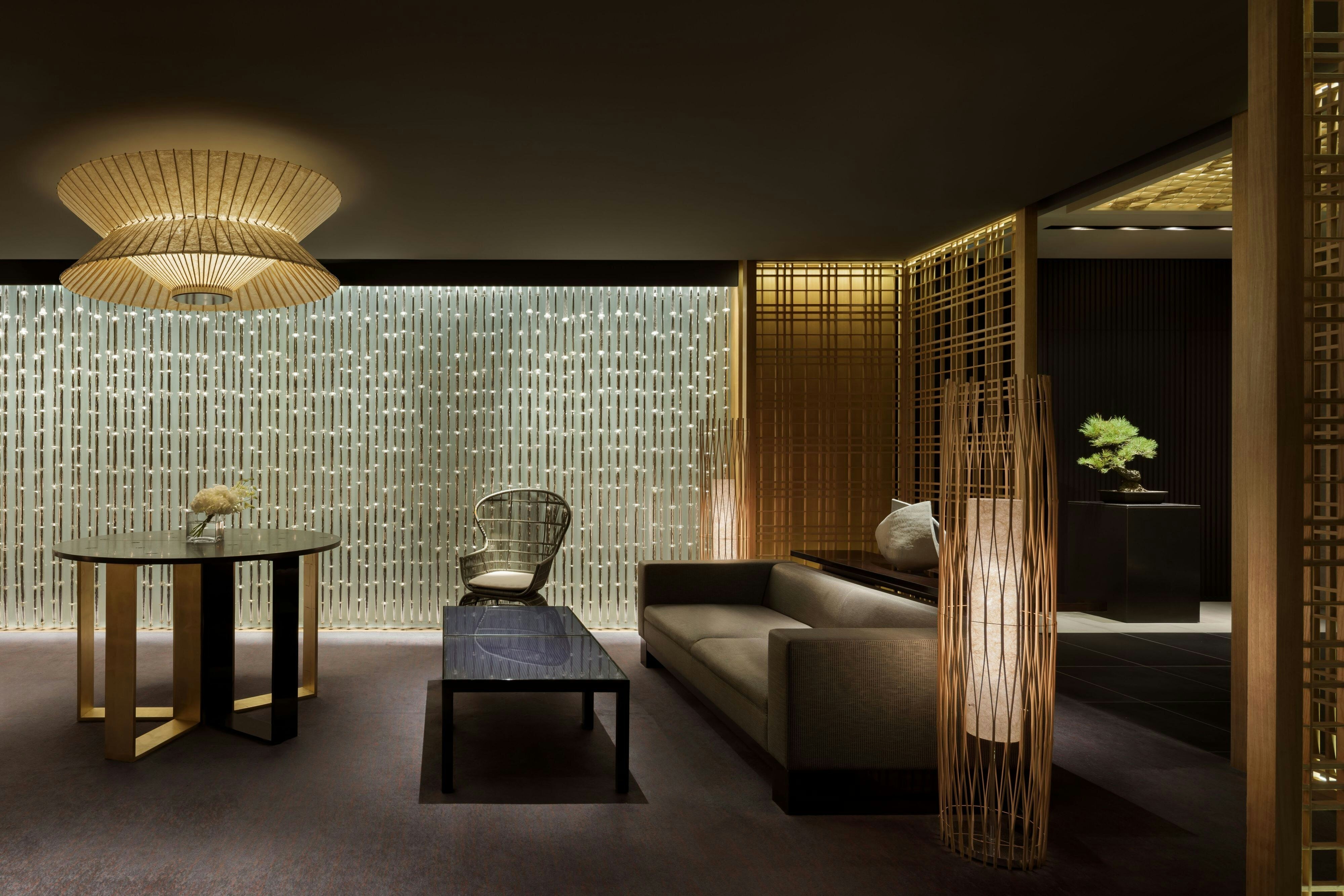
The room is the part you can verify from your desk, because serious hotels publish their numbers. Floor area is the headline: a 4-star entry room fits a bed, a desk, and a chair, while a 5-star entry room is sized to hold a separate seating area as well — The Ritz-Carlton, Kyoto opened with the largest entry-level rooms in its city at roughly 45 square metres, typical of the top of the class. The bathroom is the second tell, and often the more revealing one: 4-star bathrooms are usually tiled, single-vanity, and built around a tub-shower combination; 5-star bathrooms are stone or marble, frequently double-vanity, with a soaking tub and a walk-in shower as separate fixtures, full-size premium toiletries rather than sachets, and robes and slippers for every guest. The third difference is what happens to the room while you are out of it: 4-star housekeeping services it once, 5-star twice — a morning clean and an evening turndown, the latter written into the Hotelstars 5-star criteria as a requirement rather than a courtesy.
Dining, Wellness, and the Service Layer: Where the Gap Widens
Food and beverage is where the tiers diverge most expensively, because restaurants are staffing commitments rather than square footage. A 4-star hotel typically runs a single all-day dining room plus a bar. A 5-star runs several distinct venues with separate kitchens and separate brigades, and the strongest carry outside recognition no marketing department can manufacture: the Michelin-starred Otto Geleng at Belmond Grand Hotel Timeo in Taormina, the starred Caruso's at Rosewood Miramar Beach, Niko Romito's Il Ristorante at Bulgari Hotel Roma, Tasca by José Avillez at Mandarin Oriental Jumeira, Dubai. Wellness follows the same pattern. A 4-star gym is a room with equipment; a 5-star wellness operation is a staffed spa with treatment rooms and a thermal circuit — Bulgari Hotel Roma's runs roughly 1,500 square metres around a 20-metre Roman-bath pool — plus a real pool programme with attendants and 24-hour fitness.
Then there is the layer that never appears on a floor plan. Five-star service is anticipatory: preferences noted on day one and acted on for the rest of the stay, staff using your name by day two, a concierge who solves the restaurant problem rather than handing it back, and a property that fixes failures fast and follows up unprompted. Some brands formalise the layer outright: St. Regis properties and Park Hyatt Sydney attach butler service to every room category, not just suites. Four-star service is not worse for being different; it is scheduled rather than surrounding, and the distinction shows up precisely when you need something outside business hours.

Which Tier Should You Book — and How the Channel Changes the Answer
Sometimes 4-star is the right call, and pretending otherwise is bad advice. For a one-night transit stop, a conference stay, or a city break spent entirely outside the building, a strong 4-star property delivers most of the useful value at a materially lower rate — and a well-run 4-star reliably beats a tired 5-star. The extra money starts earning its keep when the hotel is part of the trip rather than a base for it: longer stays, resort destinations where you will actually use the spa and the pool, occasions where recognition matters, and arrivals at awkward hours when a 24-hour kitchen stops being a luxury. A rule of thumb: count the waking hours you will spend inside the property. Below roughly ten, the fifth star is largely theoretical; above it, you are buying something you will use.
There is one more variable, and it is the one most travellers never account for. The luxury brands run invitation-only preferred-partner programmes — Marriott STARS, Belmond Bellini Club, Hyatt Privé, Rosewood Elite, Four Seasons Preferred Partner, Mandarin Oriental Fan Club, IHG Destined — that attach contractual benefits to a 5-star booking made through an appointed advisor: daily breakfast for two, a US$100-plus property or spa credit per stay, upgrade priority, early check-in and late checkout where available, and VIP welcome recognition — at the same flexible rate as the hotel's own website, with no minimum stay. Since breakfast alone runs US$40 to 90 per person at this tier, those inclusions routinely amount to US$400 to 700 across three nights. Booked through WhataHotel! — operated by Lorraine Travel, a luxury advisory since 1948 — that is the real comparison to run: not 4-star versus 5-star at list price, but 4-star at list price against a 5-star room with several hundred dollars of the stay already included.